How does Google AI Mode choose its answers and sources?
Summarize with ChatGPTClaudePerplexity
TL;DR
- Google AI Mode can use query fan-out to generate multiple related searches across subtopics and data sources before synthesizing an answer.[1]
- A supporting page generally must be indexed and eligible to appear in Google Search with a snippet, but Google does not publish the final source-scoring formula.[3][4]
- Google identified Gemini 3.5 Flash as AI Mode’s global default in May 2026, while its later Gemini 4 Hydrogen announcement did not confirm Hydrogen as AI Mode’s default.[5]
- Deep Search is a separate research workflow that Google describes as using Gemini 2.5 Pro to browse hundreds of sites and create a fully cited report.[14]
- Personalization can use prior activity and optional Gmail or Google Photos connections, but Google has not disclosed how those inputs affect the ordering of cited sources.[5]
Google AI Mode is a conversational search experience that handles complex questions by generating related searches, retrieving information through Google Search, and synthesizing an answer with supporting links.[1] The broad mechanism is documented; the exact formula Google uses to score, weight, and order individual sources is not publicly disclosed.[2]
This distinction matters. Google explains how information is gathered, but not every detail of why one eligible page is selected over another. AI Mode can use web results alongside information from Google’s Knowledge Graph, real-world data, and shopping systems.[1]
What AI Mode does—and does not—reveal
| Question | What is publicly documented |
|---|---|
| Does AI Mode search beyond the original wording? | Yes. It can generate multiple related searches covering different subtopics and data sources.[1] |
| Does it use Google Search ranking systems? | Yes. Google describes retrieval-augmented generation grounded in Search’s ranking systems.[3] |
| Is there a fixed number of fan-out searches? | No fixed number is published in the reviewed documentation.[4][2] |
| What pages can become supporting sources? | Pages generally need to be indexed and eligible to appear in Google Search with a snippet.[3][4] |
| Is special AI-only markup required? | Google says there are no additional technical requirements beyond ordinary Search eligibility and SEO best practices.[3] |
| Is the final source-ranking formula public? | No. Google does not publish the precise per-source weights, thresholds, or tie-breaking rules.[2] |
| Can personalization affect results? | Yes. Google names previous conversations, Search and Maps activity, and—where connected—Gmail and Google Photos as personalization inputs.[5] |
What is Google AI Mode?
Google AI Mode is designed for questions that require exploration, reasoning, comparisons, or several research steps rather than a single lookup.[6][1] Instead of returning only a conventional list of links, it can produce a synthesized response, show supporting sources, and let the user continue with follow-up questions.[5]
The answer is not generated from a single fixed document. Google describes AI Mode as using real-time web information and retrieval-augmented generation, in which Search systems retrieve relevant material before the model composes the response.[3] The model may also use structured Google information, including Knowledge Graph facts, real-world information, and shopping data.[1]
The result should therefore be understood as a search-and-synthesis system:
- The user submits a question.
- AI Mode interprets the request and may break it into related sub-questions.
- Google retrieves pages and other information sources.
- The system synthesizes an answer.
- Supporting links are displayed alongside relevant claims or sections.
- The user can ask follow-up questions while preserving conversational context.[1]
Google has not published a complete claim-by-claim attribution algorithm. A citation shown in an answer demonstrates that Google selected the page as supporting evidence for that response; it does not reveal the page’s exact score or guarantee that the same page will appear for another formulation of the question.[7]
How does query fan-out work?
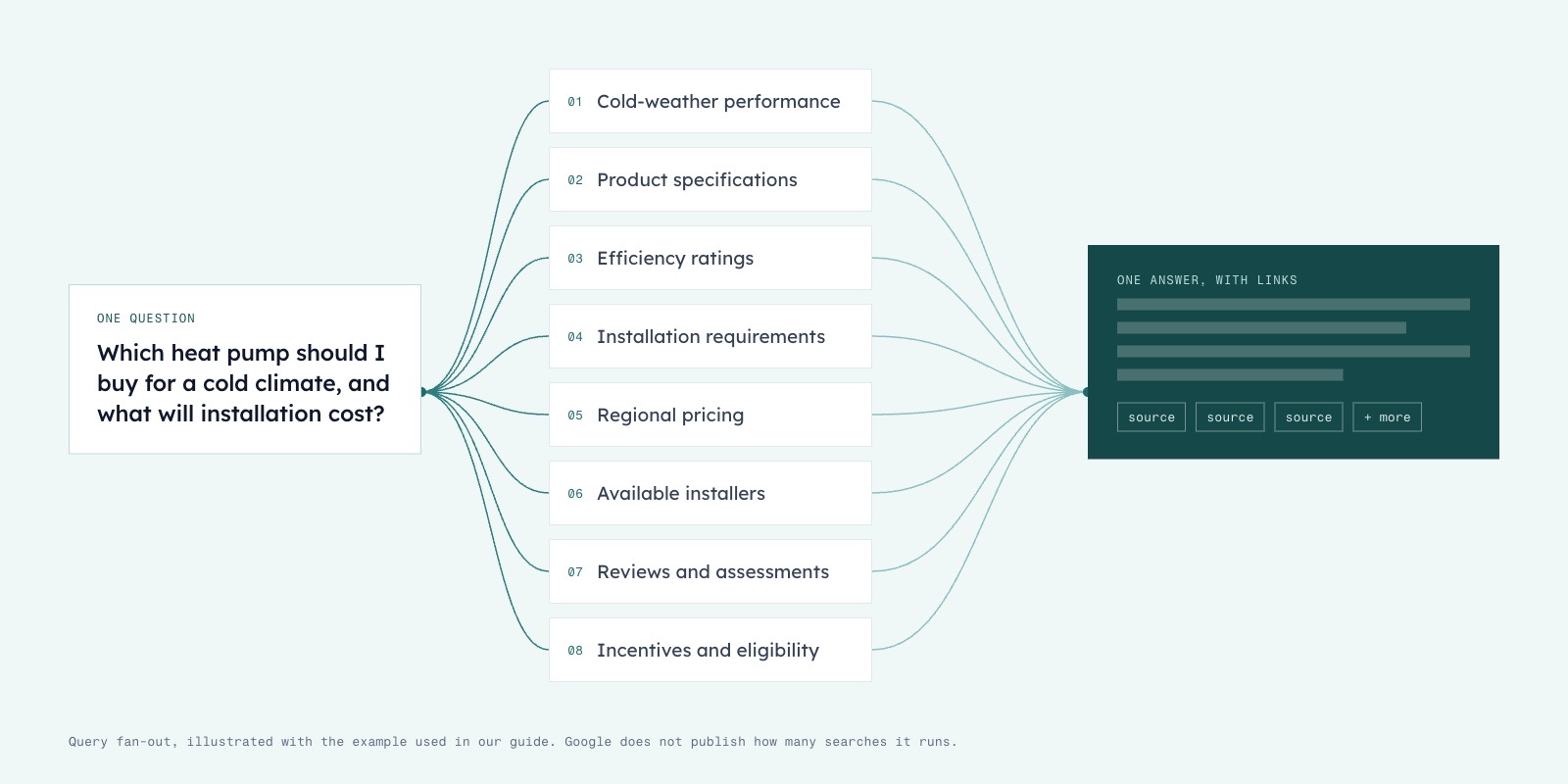
Query fan-out is the process of expanding one complex question into multiple related searches. Google says AI Mode and AI Overviews can issue concurrent searches across subtopics and data sources, then combine the results into a response with supporting links.[1][4]
Suppose someone asks:
Which heat pump should I buy for a cold climate, and what will installation cost?
AI Mode might need to investigate several distinct dimensions:
- Cold-weather performance
- Product specifications
- Efficiency ratings
- Installation requirements
- Regional pricing
- Available installers
- Reviews or independent assessments
- Incentives and eligibility rules
Google’s public example similarly describes breaking a broad question into related searches about different aspects of a topic.[1][4] The important point is not the exact number of searches. Google does not publish a universal fan-out count, and the number can reasonably vary with the wording, complexity, location, available data, and conversational context.[6] Finseo’s own query fan-out study observed AI Mode rewriting one prompt into about nine synthetic searches, 95% of which had zero search volume. That is an observed figure, not a number Google publishes.
The fan-out process
-
Interpret the question.
AI Mode identifies the user’s likely intent, entities, constraints, and implied subtopics.[1][7] -
Generate related searches.
The system can create concurrent searches covering different aspects of the request and different data sources.[3] -
Retrieve candidate information.
Google’s retrieval process uses Search ranking systems to find relevant and current pages from the index.[6][1] -
Compare and combine evidence.
The system evaluates the retrieved material while constructing a response. Google says AI Mode can identify supporting pages and provide a broader, more diverse set of links.[1][4] -
Write the answer.
The model synthesizes information into a conversational response, with links intended to support the answer.[1] -
Handle follow-ups.
A later question can use context from earlier turns to refine the user’s intent.[1][6]
Fan-out does not mean that every possible sub-question receives equal treatment, nor does it mean every retrieved page is cited. It is a retrieval strategy, not a published promise about source inclusion.
How does Google choose AI Mode sources?
Google’s public guidance establishes basic eligibility, not a complete ranking formula. A page must be indexed and eligible to appear in Google Search with a snippet to be considered as a supporting link in AI features.[4] Google also says there are no additional technical requirements specific to AI Mode or AI Overviews.[4]
That does not mean every indexed page will be cited. Eligibility only makes a page capable of being surfaced; it does not guarantee crawling, indexing, retrieval, or inclusion in a particular answer.[3]
The selection process can be separated into four practical layers:
- Eligibility: The page is indexed and can appear with a Search snippet.[3][4]
- Relevance: The page matches the question or one of its fan-out subtopics.[4][8]
- Retrieval: Google’s Search systems return the page for the generated search or searches.[6][1]
- Answer support: The system chooses whether the page helps substantiate the synthesized response.[9][2]
Google says its systems aim to show high-quality, relevant, and diverse supporting links.[10] However, the reviewed documentation does not state how relevance, quality, diversity, freshness, authority, or other signals are weighted against one another for an individual AI Mode answer.[6][3]
This is why source selection should not be described as a simple ranking position. A page might be highly visible for one fan-out query but absent from the final answer because another page better supports the combined response, because the model selected a different source type, or because the answer changed between generations. The public materials do not identify the precise reason in each case.[1]
Which Gemini model powers AI Mode?
Google’s model disclosures are date- and feature-specific. Google’s May 2026 announcement described Gemini 3.5 Flash as the new global default model for AI Mode.[5] A later Google announcement about Gemini 4 Hydrogen in Search does not explicitly state that Hydrogen powers AI Mode or that it replaced the documented AI Mode default.[6]
The safest description is therefore:
- Google has publicly named Gemini models for AI Mode at particular points in time.[11][12]
- The May 2026 product statement identified Gemini 3.5 Flash as the global default for AI Mode.[5]
- The November 2026 Search announcement introduced Gemini 4 Hydrogen in Google Search but did not confirm it as AI Mode’s default model.[13]
- Model assignments can change, so any explanation should include the relevant date.
Model choice is only one part of the system. Even when a Gemini model writes the response, retrieval still depends on Google’s Search systems and the information available to those systems.[1][12]
What is Deep Search in AI Mode?
Deep Search is a separate, more intensive research workflow within AI Mode. Google describes it as being built with Gemini 2.5 Pro, browsing hundreds of sites, reasoning across the material, and producing a fully cited report in minutes.[14]
Google says a typical Deep Search report takes about five minutes, although complex requests can take longer.[14] It can ask clarifying questions before beginning the research process.[1][14]
The feature should not be confused with ordinary AI Mode:
| Capability | Ordinary AI Mode | Deep Search |
|---|---|---|
| Primary use | Conversational answers and follow-up questions.[15] | In-depth research and longer cited reports.[14] |
| Research intensity | Uses related searches and retrieved information.[1] | Browses hundreds of sites and reasons across the material.[14] |
| Named model disclosure | Gemini model disclosures vary by date and product announcement.[6][16] | Google Help identifies Gemini 2.5 Pro.[14] |
| Output | A synthesized answer with supporting links.[5] | A comprehensive, fully cited report.[6] |
| Availability described by Google | Depends on the AI Mode rollout and market.[11][9] | Search Labs, US English, and Google AI Pro or Ultra access are described in Google’s Help documentation.[14] |
Google does not provide a fixed number of fan-out searches for Deep Search. “Hundreds of sites” describes the breadth of browsing, not a guaranteed number of generated queries or citations.[4]
How does personalization affect AI Mode?
Google has described personalization inputs rather than a complete source-ranking formula. Earlier product information identified previous conversations and places a user searched for or tapped in Search and Maps as signals that can make results more relevant.[17]
Google later described optional Personal Intelligence connections for Gmail and Google Photos, with users controlling whether those apps are connected.[5] Google’s documentation says connected content can help AI Mode tailor responses, such as using information from prior reservations when suggesting restaurants.[17]
Personalization can therefore affect the context of the answer and the recommendations presented to an individual user. The reviewed product descriptions do not explain how a personal signal changes the retrieval score or ordering of cited web pages.[6]
For publishers and marketers, this creates an important measurement constraint: two people can ask similar questions and receive different answers because of location, prior activity, conversation context, connected apps, or changing Search results. A single manual check is not a stable measure of visibility.
What do citation studies show?
Independent studies show that AI Mode citations vary by dataset, date, query wording, and measurement method. Their results should not be treated as a universal ranking formula.
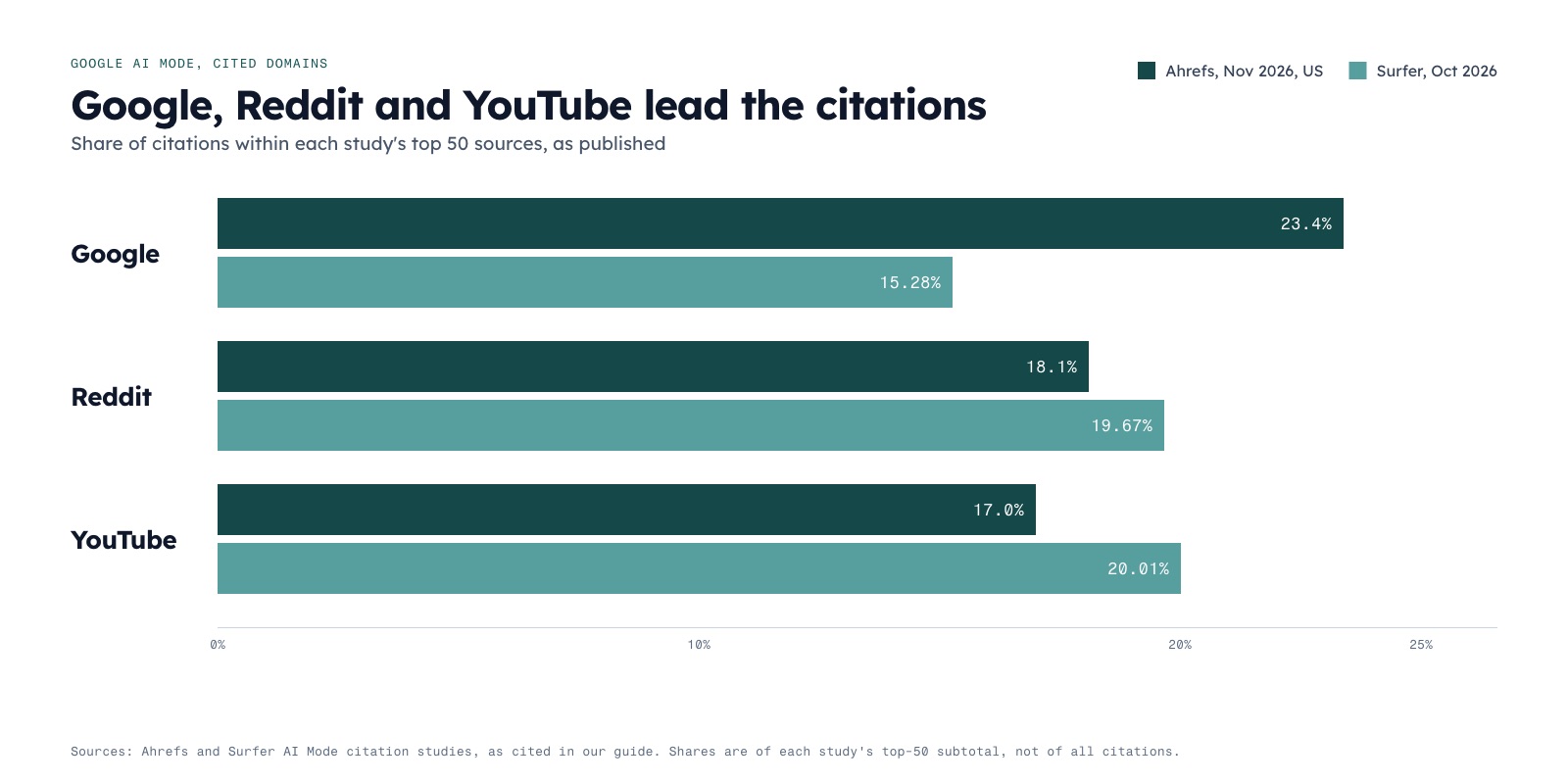
Ahrefs’ November 2026 snapshot reported domain citation shares of 23.4% for Google, 18.1% for Reddit, and 17.0% for YouTube across broad US queries; the percentages represented each domain’s share of citations among the measured top sources.[18] The study did not disclose a numeric query-count sample size.[6]
An earlier Ahrefs comparison examined 540,000 query pairs for citation and URL analysis and reported that the same URLs appeared in AI Mode and AI Overviews 13.7% of the time, rising to 16.3% for the top three citations.[7] The study used single generations of responses and noted that citations can change between generations.[6][7]
SE Ranking’s study of 10,000 US keywords collected on June 20, 2025 found 9.2% URL matching across three tests and reported 14% exact-URL overlap with organic top-10 results.[2] Those figures describe that study’s keyword set and collection date, not all AI Mode searches.[6][18]
These findings support a limited conclusion: citations can be measured, but citation patterns vary. They do not reveal the hidden weights behind a specific source choice, and they should not be used to infer that a patent or a study has uncovered Google’s production ranking system.[2]
What should publishers optimize for?
Google’s guidance does not require a special AI-only schema, file, or markup format. Pages need to be indexed and eligible to appear in Search with a snippet, while ordinary SEO best practices remain relevant.[4][3]
Practical priorities include:
- Create useful pages that answer real user questions rather than producing a separate page for every imagined fan-out variation.[3]
- Cover the important subtopics that a complex question naturally raises.
- Make key claims clear, specific, and easy to extract accurately.
- Use descriptive headings and page structures that help readers and retrieval systems understand the topic.
- Keep factual and time-sensitive information current.
- Support important claims with appropriate evidence and explain the limits of the evidence.
- Avoid scaled content created primarily to manipulate Search or AI responses; Google identifies that tactic as scaled-content abuse.[3]
- Measure citations across repeated checks, prompt variants, locations, and dates rather than relying on one answer.
The objective is not to guess a fixed fan-out template. Google does not publish one. The more durable approach is to build genuinely useful content that addresses the underlying information need across the subtopics AI Mode may investigate.[3]
What do Google’s query-related patents reveal about AI Mode?
Google patent application US20250181575A1 describes a method for identifying related queries and formulating a combined query using parameters from those queries.[19][20] The application was filed on January 31, 2025, published on June 5, 2025, and the patent record reports a grant on April 21, 2026.[6]
The patent is relevant technical context, but it does not prove that AI Mode uses the claimed invention in production.[10][6] Google’s Search Central documentation is the direct evidence for the product-level claim that AI Mode can use query fan-out.[4][3] A patent should therefore not be presented as a disclosure of AI Mode’s live source-ranking algorithm.
Frequently asked questions
How does Google AI Mode work?
AI Mode can interpret a complex question, generate related searches, retrieve information through Google Search, and synthesize an answer with supporting links.[1] It can also use Google information such as Knowledge Graph facts, real-world information, and shopping data.[1]
What is an AI Mode query fan-out?
Query fan-out is the expansion of one question into multiple related searches across subtopics and data sources.[1][10] Google documents the mechanism but does not publish a fixed number of fan-out searches for each prompt.[2]
How does Google AI Mode select sources?
A supporting page generally needs to be indexed and eligible to appear in Google Search with a snippet.[3][4] Google does not publish the exact scoring, weighting, or ordering formula that determines which eligible pages are selected for a particular answer.[6]
Does AI Mode use Gemini?
Yes, Google has identified Gemini models in its AI Mode disclosures, including Gemini 3.5 Flash as the global default in the May 2026 announcement.[5] Google’s later Gemini 4 Hydrogen announcement for Search does not explicitly confirm Hydrogen as AI Mode’s default model.[13][6]
What is Deep Search in Google AI Mode?
Deep Search is a more intensive AI Mode workflow that Google says uses Gemini 2.5 Pro, browses hundreds of sites, and produces a fully cited report in minutes.[14] Google describes access through Search Labs for Google AI Pro and Ultra subscribers in US English.[14]
Can Google AI Mode personalize its answers?
Yes. Google has described using previous conversations, Search and Maps activity, and optional connections to Gmail and Google Photos for more tailored responses.[5] Google has not published a formula explaining how those signals change the ranking of individual cited web pages.[2]
Sources
- 1AI Overviews and AI Mode in Search — search.google
- 2AI Mode Research: Sources, Volatility, & Differences between AIO and Organic Search — seranking.com
- 3Google's Guide to Optimizing for Generative AI Features on Google Search | Google Search Central | Documentation | Google for Developers — developers.google.com
- 4AI Features and Your Website | Google Search Central | Documentation | Google for Developers — developers.google.com
- 5Google Search’s I/O 2026 updates: AI agents and more — blog.google
- 6Query Intent and Google Rank as Joint Predictors of AI Citation: A Multi-Platform Observational Study — aixiv.science
- 7Are AI Mode and AI Overviews Just Different Versions of the Same Answer? (730K Responses Studied) — ahrefs.com
- 8Get AI-powered responses with AI Mode in Google Search - Computer - Google Search Help — support.google.com
- 9US20250181664A1 - Multi source extraction and scoring of short query answers - Google Patents — patents.google.com
- 10Expanding AI Overviews and introducing AI Mode — blog.google
- 11AI in Search Reduces Publisher Referrals Without Improving User Experience: Experimental Evidence — arxiv.org
- 12Source Coverage and Citation Bias in LLM-based vs. Traditional Search Engines — arxiv.org
- 13Google Search upgrade: Gemini 4 Hydrogen features — blog.google
- 14Use Deep Search in AI Mode for in-depth research - Google Search Help — support.google.com
- 15Google AI Mode - a new way to search, whatever’s on your mind — search.google
- 16US20250068633A1 - Multi-channel search and aggregated scoring techniques for complex search domains - Google Patents — patents.google.com
- 17AI Mode in Google Search adds personalization, agentic features — blog.google
- 18The 50 Most-Cited Websites in Google AI Mode (November 2026) — ahrefs.com
- 19US20250181575A1 - Combining parameters of multiple search queries that share a line of inquiry - Google Patents — patents.google.com
- 20US11762848B2 - Combining parameters of multiple search queries that share a line of inquiry - Google Patents — patents.google.com